Personal fundraisers, or how peer to peer fundraising works.
For several years now, a phenomenon has existed that has turned the world of philanthropy completely upside down.
For several years now, a phenomenon has existed that has turned the world of philanthropy completely upside down. If you wanted to contribute to a good cause 20 years ago, there weren't many ways to do it. Online giving was still in its infancy and hardly anyone had heard the term p2p. Today, things are different. Personal fundraisers, also known as peer to peer fundraising (p2p), are on the rise and increasingly popular with everyone who likes to support meaningful causes.
WATCH THE VIDEO
You too can easily start your own campaign and support a nonprofit organization that is close to your heart.
How? Run marathons, celebrate birthdays and take on crazy stunts for a good cause. Why? Because it's worth it! At Darujme.cz we have plenty of experience with personal fundraisers, and we're passing it on to you in the form of a few simple tips on how to pull off a campaign like this.
If you're not sure how to approach your campaign or where to start, follow the steps below. And if you're still not sure after that, get in touch with the nonprofit organization you plan to support or write to us at Darujme.cz – we'll be happy to help.
How to do it:
1. Choose your event – the campaign
First, decide on the occasion for which you want to collect donations. The evergreens of the peer to peer fundraising scene are all kinds of sporting activities such as running a marathon, a demanding hike or a cycling race. Close behind in frequency are campaigns launched for life events such as birthdays, the birth of a child, anniversaries, weddings or other celebrations. But there are also all sorts of personal bets, such as shaving your head, a parachute jump or quitting smoking.
2. Let the nonprofit know what you're planning
Have you already picked a challenge you want to take on or an event you're planning to celebrate? Pick a project run by your favorite nonprofit (for example here) and don't hesitate to contact them. Explain what you have in mind and think carefully about your answers to these questions – why do I want to take on this campaign, what do I want to raise money for, how much do I want to raise, do I have any other goals? This will help you later when writing the text of your campaign and preparing for tricky questions from those around you. It's also a good idea to agree with the nonprofit on help with promoting the campaign (sharing on social media or in their newsletter). The organization can of course support you in other ways too – after all, two heads are better than one.
2. Create your campaign page
It won't work without a proper page! Luckily, with Darujme.cz it only takes a few minutes. It pays to give your campaign page the attention it deserves, as it will be your main means of communication. Play around with its settings and, above all, with the text and photos. On Darujme.cz you can naturally set up a thermometer – a target amount (to show the donations already received), the amounts of the individual donation buttons or the option to enter a custom donation amount. You also have a choice of standard graphic backgrounds and the option to add extra photos or videos.
3. The text of your campaign
First of all, christen your campaign – come up with a name. Stick to the golden rule: short, clear and to the point. The name should refer to the ambassador and to what the campaign is about. However important the name is, don't underestimate the basic summary either. This is a short text of no more than 5 sentences that sums up the campaign and, ideally, also contains a call to action. Let your imagination and sense of humor run free – people will find it easier to donate if the campaign makes them smile too.
In the next text, the campaign description, tell your donors what you're doing, why you're doing it, who you're doing it for and when you're doing it. Around 250–300 words is optimal. A clear description and a clear story are the foundation! Bear in mind that people don't read much in the online world, so sometimes less is more.
For sporting campaigns or ones where you're pushing your limits, it has proven effective to stress that it really is a physical challenge for you and that it might even hurt. Research does show that people give more to campaigns that aren't exactly a walk in the park. For birthday, wedding and similar campaigns, don't be afraid to highlight that you're giving up presents in favor of supporting the chosen project or organization.
Peer to peer campaigns are not a crowdfunding portal or an e-shop. What it's really all about is donations. If you wish, you can motivate donors with some kind of personal reward. For example, you could bring the most generous donor a souvenir, cook them dinner or invite them for a coffee or a beer. However, giving in a personal fundraiser should not primarily be tied to anything in return.
4. Set a target amount
Think carefully about the target amount you would like to raise for the chosen project or organization. The target amount is your personal goal; it has no effect on whether the money is sent to the organization. All donations received are always forwarded to the organization, regardless of whether more or less is raised. The amount you set is a psychological threshold. Both you and the donors you approach will find it easier to meet a reasonable goal than to keep chipping in indefinitely. It's also easier for donors to judge how much to give, and seeing the target amount motivates them to help reach it. When setting your goal, consider how much the people around you can really afford to give. There's nothing worse than the frustration of a needlessly high target that isn't being met.
Consider the following:
How many people do I plan to actively approach?
Bear in mind that roughly a third of the people you approach directly will donate.
How much can an individual from the group of people you approach give? Keep your estimates on the conservative side – consider their jobs, their experience with giving and whether the chosen project is likely to appeal to them.
Multiply the number of likely donors by the predicted donation amount and you have your target.
Generally speaking, the most common donation is between CZK 200 and 500, and the most common target amount is CZK 10,000–15,000.
It's always nicer to exceed the target amount than to fall short of it – both for you and for everyone who contributed. On the other hand, don't set your goals too low, and motivate yourself to take action. Remember that no donation is too small, and supporting your chosen nonprofit through your own efforts is priceless.
5. Timeline
Set the time frame in which your campaign will run. This information will be shown on the campaign page. The time frame helps donors judge whether the campaign is current and increases its credibility. As a rule, 1 campaign = 1 month.
It's best to launch the campaign 2–3 weeks before the actual event tied to it and to close it a week after the event. Experience shows that most donations come in at the start of the campaign, then just before the event, and finally a few days after it.
Once the campaign has run its course, it's a good idea to close it. On Darujme.cz, a closed campaign looks like this: when visitors open its page, they see a notice that the campaign has ended and it is no longer possible to donate. Feel free to add a thank-you, a recording of the event or a final update to the closed campaign. There are no limits to your imagination.
6. Use your contacts
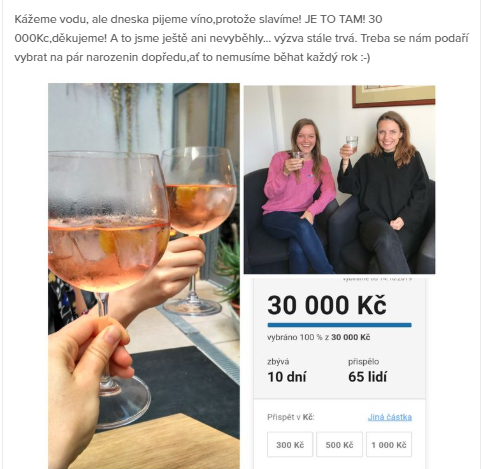
The success of personal fundraisers rests above all on the personal dimension. So spread your campaign among friends, family and colleagues, and don't be afraid to reach out to people you know via social media too. Direct channels such as e-mail, a phone call or a message on Messenger work great for reaching people. A Facebook post can help your campaign, but it lacks the element of direct personal contact. The rule is: the more people you reach, the higher the amount raised. But the chances that people will support you are higher if you approach them personally.
7. Update the content
Your campaign page should be constantly alive. Add pictures, videos, stories and comments, and share your progress there too. Post photos related to the theme of your campaign. Running a marathon? Use a photo of yourself in your running kit. Celebrating a birthday? Find a photo from an earlier party. You, as the ambassador, should be in at least one of the photos; the others can be illustrative as needed. Don't hold back – use the memes and GIFs that are popular right now, or an educational infographic about the project you're supporting. Anything that feels like you!
Add a video to your campaign too. In a video greeting, sum up the purpose of the campaign, share your progress in training for the marathon, and so on. Videos should be short, around one minute. Don't worry about quality at all – a short YouTube video shot on your smartphone is more than enough.
8. Thank-you
Your donors definitely deserve a thank-you. It seems obvious, but really don't forget it. A short e-mail or a message on Messenger often does more than you'd expect. Every donor automatically receives a donation notification from Darujme.cz, but still, a thank-you from you is irreplaceable. Ambassadors also often say thank you together with the nonprofit they raised money for. And that's a great approach, because giving is always about trust and relationships.
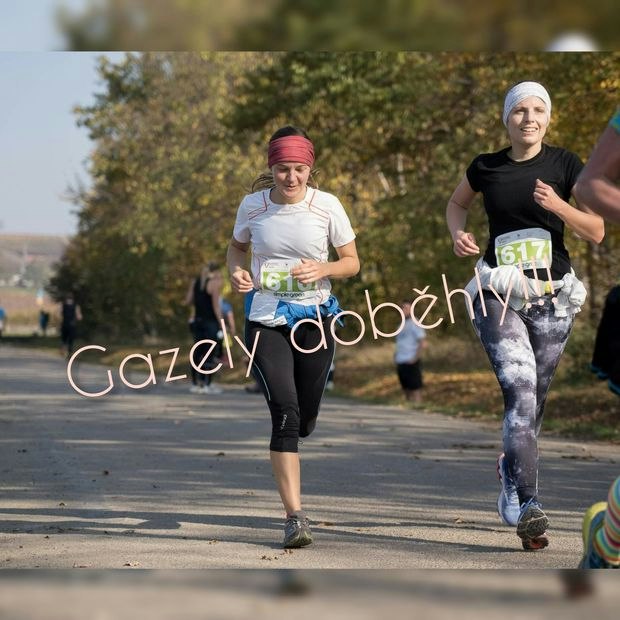
Made it all the way here? Thank you! We trust you now know how to go about it. If you feel like it, get inspired by a few successful campaigns from Darujme.cz:
We're keeping our fingers crossed for you and looking forward to lots of new personal fundraisers!
The Darujme.cz team (podpora@darujme.cz)