Interview with Nevypusť duši: It's okay to want to be well and to feel good.
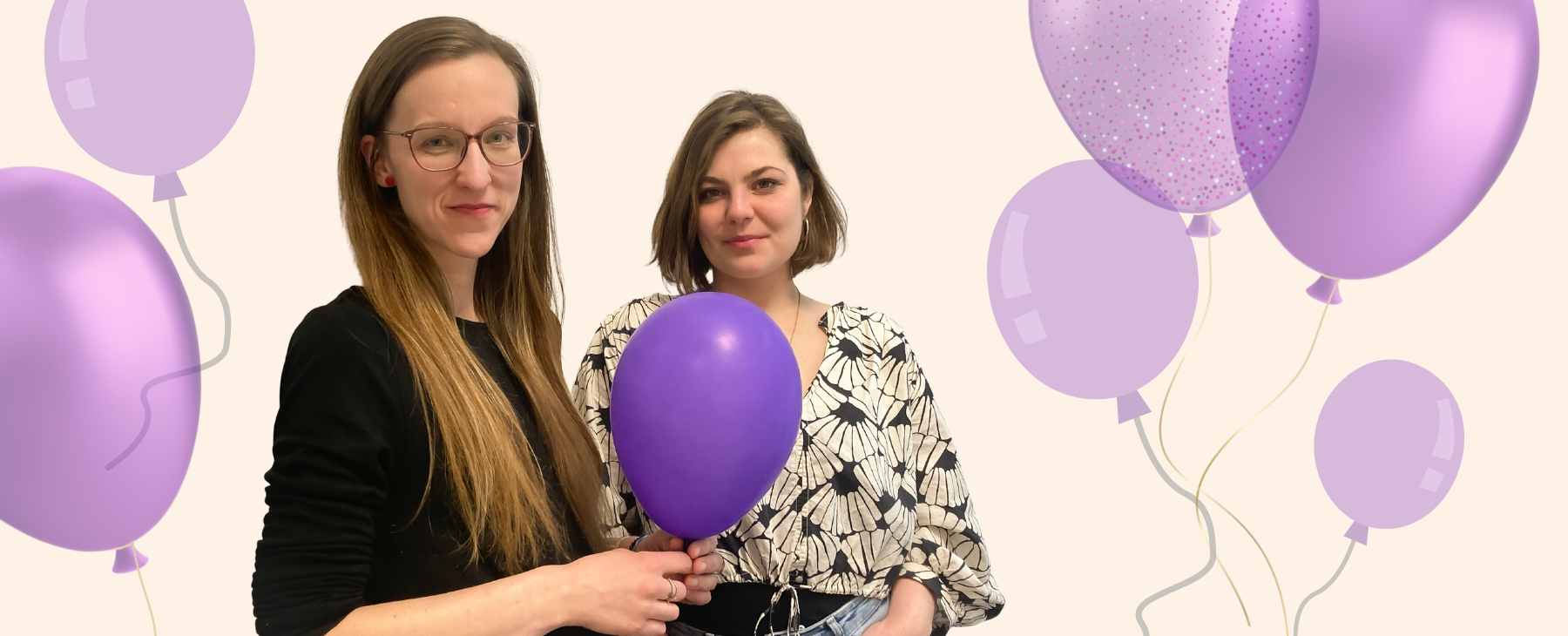
Nevypusť duši (roughly, "Don't give up the ghost"). Doesn't the name speak to your soul too? It belongs to a nonprofit organization whose mission is awareness and prevention in the field of mental health, especially among young people. The organization was founded in 2016 by two students, Marie and Tereza, who had their own experience with mental illness. What started as a Facebook page gradually grew into a successful and well-known nonprofit. Since then, the Nevypusť duši team has grown to 10 members in the core team and more than 30 lecturers, most often students of psychology, medicine or the helping professions, who lead one of the several programs Nevypusť duši runs. You can't miss the purple Nevypusť duši balloon, which is also a symbol of the soul.
Nevypusť duši has original, clear and very nicely built communication. Alongside communication, the organization takes a systematic approach to fundraising, including online. And that is what interests us at Darujme.cz. Today we are talking with Míša Plšková from fundraising and Aneta Brunerová from PR.
Ladies, how long have you been at Nevypusť duši and what brought you to what you do?
AB: Neither Míša nor I have been at ND for long – in my case since October 2022. By training I'm a social anthropologist, and throughout my studies I always learned to look at the world around me from a broad perspective and to notice where someone needs help. In the field of mental health that applies twice over, and the philosophy of Nevypusť duši matches my conviction that we need to strive for a world where people are equal in their ability to ask for help and to receive it. I had been following ND's activities for quite a while and didn't want to let the open position of communications manager slip away. My heart still skips a beat now and then at how big a love brand ND is, and that makes every day of work a real pleasure.
MP: Although I've been at ND for a fairly short time, I'm all the happier that our paths crossed a year and a half ago.
Before that I worked for another nonprofit organization, where I coordinated one of the projects, and part of that job also involved, on the side, writing things like grant applications or materials for potential project partners. That interested and attracted me. How do you approach a potential partner so that they decide to join forces with you? How do you build that relationship and how do you keep nurturing it? And that is exactly what I can now do at Nevypusť duši. We are working to diversify our income across corporate, grant and individual sources.
It's important to me to share the same values as the organization I work for and to believe in its mission. At Nevypusť duši I feel fully in tune with that, and its very focus – caring for mental health – was the reason I wanted to set out on this shared journey. Thanks to my work in fundraising, I can invite others along on this journey too. At Nevypusť duši we are always delighted by every donation from our donors. And as Anet put it so nicely, our hearts always skip a little beat. At the same time, we greatly value the trust of our partners who have joined us so that together we can create a world where nobody has to run themselves into the ground.
Can you tell us what percentage of last year's donations came in online?
At the moment we haven't closed the books on 2022 yet. But we can say that it's approximately 11%.
How important is Darujme.cz in your work? How exactly do you use it most often?
MP: We see Darujme.cz as an important partner that lets us share the mission of Nevypusť duši clearly and comprehensibly and connects us with people who want to join that mission. Since darujme.cz is one of the well-known and established donation platforms, it also gives potential new donors – people we reach through our activities (fundraising campaigns, social media, workshops, etc.) who haven't encountered us more closely before – an extra measure of trust in our work. That is very valuable to us. Darujme.cz accompanies us at Nevypusť duši all year round. We use it as one of the places where we can, so to speak, meet our donors who are looking for a way to support mental health care in our society. That's why we have two long-running projects open on Darujme.cz that describe not only what Nevypusť duši focuses on, but also what we can actually turn the financial support from our donors into. To make sure people know about our profile on darujme.cz, I work with Anet on how we communicate the mission of Nevypusť duši, but also its impact. In the fall we usually launch a new campaign as well, always aimed at supporting a specific Nevypusť duši activity. At the same time, darujme.cz is an important place where we can get the data we need about our donors, so that we can thank them for their donation and also keep them informed about the impact their help is having.
AB: From a marketing and PR perspective, I would just add for my part that, thanks to darujme.cz, our group of donors has an almost community-like character. We see our recurring donors as a group of close people we enjoy communicating with regularly, and we're happy every time someone new joins them. When Míša and I were switching from one email client to another last month, we both already knew some of our donors by name and knew we mustn't forget to add them to the new contact list.
What campaigns are you planning for this year?
MP: Right now, together with Anet and other colleagues on the team, we are thinking about what kind of campaign to create for this year and what shape to give it. When planning a campaign, we always start from the real needs of Nevypusť duši and its mission, while also reflecting what is currently happening around mental health in society.
At the given time, we assess our biggest needs and build a specific fundraising campaign around them.
AB: Exactly as Míša says – we always try to respond to what is happening right now. That makes it harder for us to come up with campaigns far in advance, because the topics that are resonating and need addressing often arrive unexpectedly and in waves. But we've found that we're actually more productive as a team when something hits us, inspires us and motivates us to think and create quickly. :)
On your website you spell out very clearly exactly where every hundred crowns donated to you will go, and you encourage recurring support. How do you target recurring donors, and how important are recurring donations for you?
MP: One of the goals of Nevypusť duši is to be a comprehensible and transparent nonprofit organization. That naturally carries over into fundraising, where it also matters a great deal that fundraising at Nevypusť duši doesn't operate separately from the organization's other parts (our pleasant collaboration with Anet is proof of that), but is interconnected with and complements them – which is also down to the excellent setup and the active involvement and interest of our director (as well as our founder and previous director) in the whole process. We see fundraising as a space where we can inspire more people to support mental health, and that takes many forms – donating, but also sharing our articles and infographics, and so on. All of it together is a tremendous source of energy and joy for our work at Nevypusť duši, and in turn we try to give that back to our donors – the joy of what we've been able to achieve together with them in caring for mental well-being, how their donation helped children and young people learn to look after their mental health in time, and how their donation, given for example to the Duševní zdravověda (Mental Health Basics) workshop, can give those children and young people the courage to confide in someone or seek professional help. Anet and I are currently creating a new strategy for taking care of our donors, so that they feel good with us at Nevypusť duši and know how their donation is helping.
We focus not only on keeping donors well informed, but also on thanking them, which we do several times over the course of the year. For example, we give our donors free access to a webinar on mental health. That way they get to experience a piece of our practice first-hand, and we also see it as an opportunity they can draw on to care for their own mental health or that of their loved ones. Every year we also make sure not to forget Giving Tuesday and the Christmas and New Year period, when we want to thank our donors not only for their generosity and kindness, but also for the journey they have taken with us toward supporting mental health in our society.
Recurring donations help us a great deal in that we can plan our activities ahead; they give us the certainty that, together with these donations from our donors and thanks to the long-term support of our partner organizations and companies, we will be able to meet the goals we've set, and at the same time they give us the footing to respond effectively to needs that may arise during the year.
AB: One part of the new strategy for taking care of our donors is, for example, a regular quarterly newsletter, which is taking shape in our hands right now. We want everyone who supports us to know that their donations really are put to clear use and that it is thanks to them that we can work on all the projects we are involved in. Although we try to speak mainly in quantitative data – that is, how many workshops we can run for a given donated amount, and so on – we care about not losing sight of the qualitative impact that every single donation has. One workshop affects the lives of up to thirty young people, and although none of us can tell exactly how it will change the trajectory of their lives, we know from the feedback on our workshops that they are seen as very supportive and helpful and that they give young people courage.
Mental health has been a much-discussed topic in recent years. We've been through covid, there is a war going on in Ukraine, and the fast pace of life in general brings its own challenges. Has the dynamic of giving at your organization changed in any way over the last three years – are you gaining donors, do you have more recurring donations, or is acquisition easier? Do you see any trend?
MP: Yes, both covid and the war in Ukraine had a clear effect on the dynamic of giving. Essentially, we can speak of a temporary outflow of donors who decided to direct their financial support to where it was most needed at the time. We could see that right after the start of the war, when a huge wave of solidarity and financial support rose up for the areas and people affected by the conflict.
Both covid and the war in Ukraine are also two events that have had a global impact on mental health as well. We can still see the effects of covid on the mental health of children and young students today when we look at research data mapping the situation in secondary schools, for example – which is exactly what we do in the research running alongside our Zázemí pro duši (A Home for the Soul) program. During covid we tried to draw attention to the difficulties that come with moving into the online space and to show parents and children how to cope better with that transition and the demanding situation. We can certainly say that during covid the number of our donors nearly doubled, while over the past year it returned to pre-covid levels. At the same time, we're glad that many of our donors have accompanied us with recurring support for several years.
AB: We managed that also thanks to a very successful fundraising campaign in support of our activities, which we launched at the time. As for the war in Ukraine, we tried to respond promptly and in the way closest to us – thanks to the support of our partners and donors we created a bilingual brochure, Podpora duševního zdraví v době válečného konfliktu (Supporting mental health in times of armed conflict), which is still available on our website, and at the start of the war we actively distributed it, together with our partners and allied organizations, to the places where people from Ukraine were first getting to know their new surroundings and coming to terms with the horrors they had lived through. Nevertheless, over the last three years we have observed that interest in mental health and in supporting it is stable and, if anything, rising – which we see not only in the number of recurring and long-term donors (some have really been with us from the very beginning), but also, for example, in the growth of our followers on social media.
Who are your typical donors? And perhaps that has changed in recent years too?
MP: Although we have never focused on a detailed analysis of the makeup of our donors, we have various statistics, for example from our website or social media, that give us a rough idea of who supports us. They are often people who have personal experience with mental illness, either themselves or in someone close to them, people who are interested in what we do professionally (teachers, for example), and also the young generation, for whom the topic of mental health is close to heart.
And now allow us a few questions about mental health. Overwork and burnout unfortunately affect people in the nonprofit sector often, and almost systemically. What do the first signs that burnout is approaching look like?
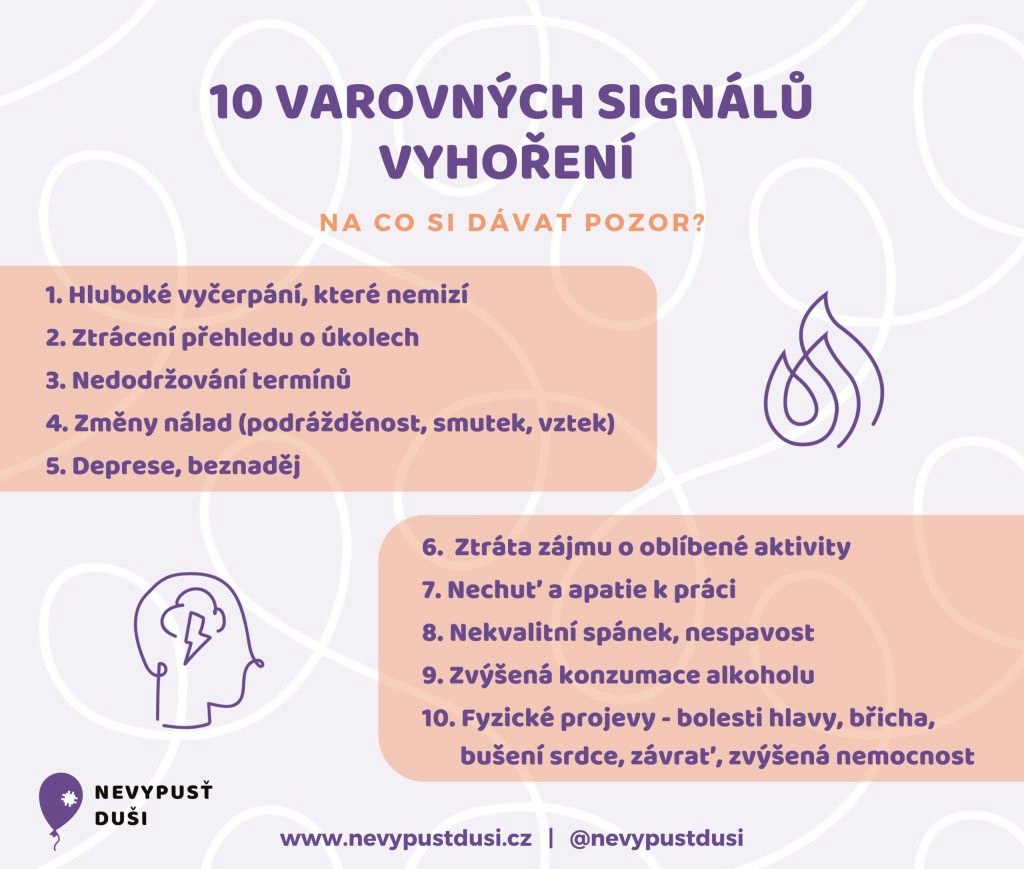
AB: You're asking about one of the topics we're currently focusing on at Nevypusť duši, in several of our programs at once. At Nevypusť duši we see burnout syndrome as a specific manifestation of chronic, or long-term, stress, which people often succumb to at work, but also, for example, while studying or in the role of caregivers, such as on parental leave. Burnout shows up in three spheres – psychological, physical and social. A person who is slowly starting to burn out, as we say at Nevypusť duši, usually loses interest in activities they used to enjoy, becomes apathetic and frustrated, and feels very exhausted. This is often accompanied by things like sleep problems and headaches, and in the social sphere, for example, by communicating less with colleagues or even withdrawing from loved ones.
We have a nice, clear infographic on exactly this topic – the warning signs of burnout
, which we'll gladly share with you so your readers know what to watch out for. So that burnout doesn't have to happen, this year we've prepared a brand-new
program
for companies and the public that deals with burnout and its prevention and teaches employees and company leadership alike how to prevent burnout syndrome and recognize in time when it's coming. We also actively share the contacts people need for the services available at the moment when we no longer feel well and need a helping hand.
Do you have personal experience with burnout, yourself or in people around you?
AB: I think Nevypusť duši is a great example of a well-designed work environment that looks after the mental health of its employees and tries to prevent burnout syndrome – and that has worked out for all of us in the long run, not least in our effort to live and work in line with what we tell the world. Míša and I have both met plenty of burned-out faces in our lives, whether during university or among friends who don't necessarily work in the demanding corporate circles primarily associated with burnout, but for example in creative fields, where the pressure to perform and be original is very high. At Nevypusť duši we also think primarily of the helping professions and of primary and secondary school teachers, who often encounter burnout.
What works for you personally as a defense?
AB:
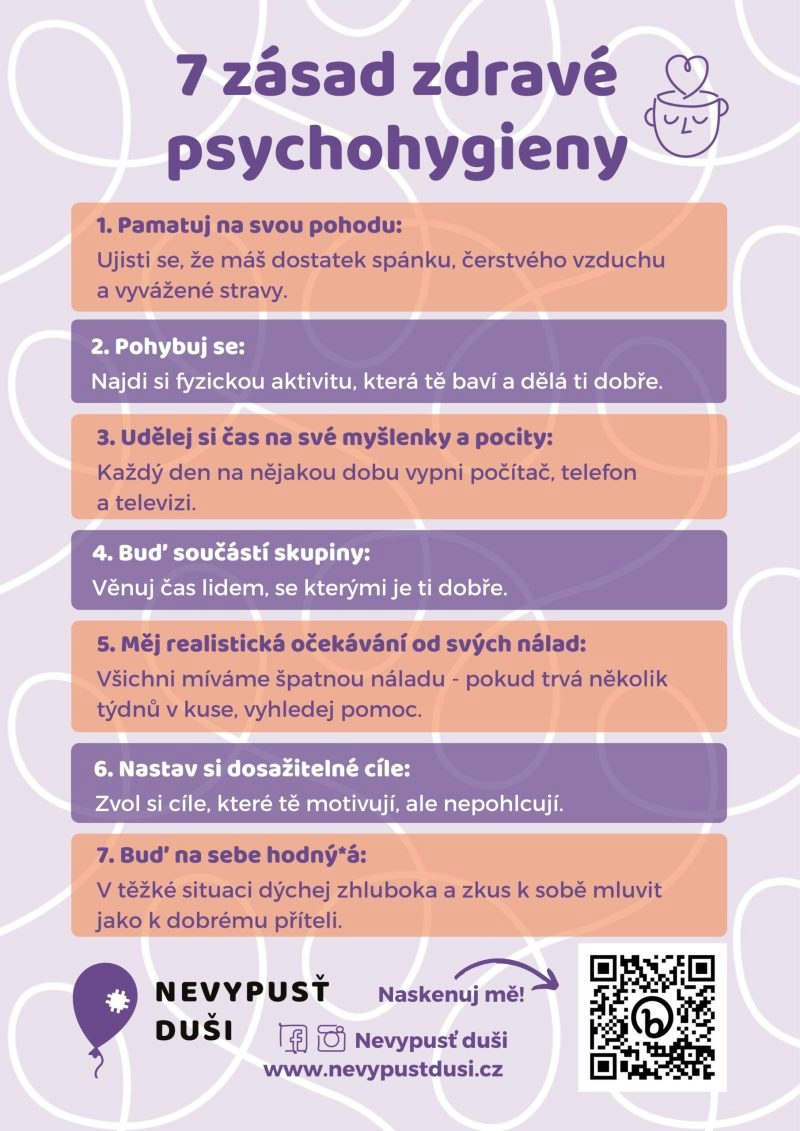
Do you know the 7 principles of healthy mental hygiene
, one of the best-known infographics we've created at Nevypusť duši? It contains seven points worth keeping in mind when we want to take care of our mental health and thereby prevent difficulties such as burnout syndrome.
"What I find most important is to give my own well-being a sufficiently important place, and not to forget that it's okay to want to be well and to feel good."
Just as essential is not overstretching yourself and having realistic expectations of what you do – whether it's work, hobbies or anything else. We all have our limits and our own pace, and it's good to be aware of them and to know them, and to relax too. Our team has a wide range of hobbies and ways to unwind: from trips into nature to playing the piano and watching films to evenings on the PlayStation.
MP: As Anet already mentioned, a wide range of hobbies works for me too. That's why I regularly go to the mountains with friends and family, I climb, and we spend time together. That's how I clear my head of the workload and recharge so that I have energy to draw on during the working week. Nature and time with my family simply recharge my batteries. The support and company of people close to us is also something that we at ND think shouldn't be underestimated, and we very much wish that each of us were able to notice when someone close to us isn't doing well, and at the same time to ask for a helping hand at the moment we need one ourselves.
Do you also work with employees in the nonprofit sector?
MP: At Nevypusť duši we see cooperation with other nonprofit organizations that share the same focus and values as essential for achieving common goals in mental health care. At the same time, nonprofit organizations that are interested can also order one of our programs dedicated to supporting mental health.
AB: As Míša says, our programs for companies and the public are available to everyone who is interested in them. Nonprofit organizations and the public sector in particular have an advantage over companies in that the program prices are lower for them. What's more – and this is new this year – we are planning to get a course for social services accredited; it will be eight hours long and will be aimed directly at people in the helping professions as part of their continuing education.
After covid we all moved a great deal online. By that I mean that working from home and online meetings are the norm; on the one hand there's no longer such a need to meet in person, which saves time, but on the other hand we spend far more time in the company of a screen alone and somewhat drift out of reality. How has the way you work changed specifically? I imagine that for you it's very much about personal contact. What would you recommend as a healthy online–offline mix?
MP:
In 2020, in response to the marked deterioration in the mental condition of the entire population as a result of the Covid-19 pandemic, we also transformed our programs into online formats. For example, we created online webinars for secondary school students, teachers and the public, and we continue to offer some of these newly created activities as part of our programs. Although, as you mention, personal contact is very important in our programs. These steps – transforming our programs into online formats – were possible precisely thanks to the great support of our partners and, at the same time, the great generosity and support of the donors who supported Nevypusť duši during the Covid-19 period.
AB: In my view, ND runs on nice compromises: thanks to the way the organization's leadership is set up and to how well communication works in the team, we can combine the online and offline worlds however we need. We like seeing each other together at the office, we have lunch together every Wednesday and we meet every Monday morning for a regular catch-up, but otherwise our working hours are very flexible, and if one of us needs to work from home for a longer stretch or likes going to yoga at three in the afternoon, it's no problem for anyone. It's a system built on the trust that we all want to do our job and enjoy doing it – whether from the office or, say, from a cottage in the mountains. The online world, with all its apps and communication channels, gives us greater flexibility with our time and also gets our content to a wider range of people, including those whom in-person workshops might never reach at all.
Teamwork is also important to us. There are about ten of us on the team, and it would show immediately if someone didn't have the same passion for the work as the others. It's all about cooperation.
MP: Yes, mutual trust is a very nice commitment for us, one that nobody wants to let down.
To close, is there anything you would like to say to your colleagues in the nonprofit sector, whether fundraisers or people in direct care?
AB: On behalf of ND, I'd like to tell all our colleagues in the nonprofit sector that your work is important, and that in order to do it well and beautifully, you need to be well yourselves. That isn't just an empty phrase. Our shared goal is for all of us to be better off in this world. To achieve that together, we have to start with ourselves.
MP: To my fellow fundraisers I would probably like to say: let's try to find ways to connect donors with the people we help, and let's make sure donors have the chance to see how their donations are helping to change the world for the better.