17 proven tips for your fundraising. Tested in practice by 4 European nonprofit organizations.
We have summarized tips for the success of your fundraising campaigns. All of them are tried and tested in practice!
In May of this year (2024), we had the honor of hosting a unique international webinar in which four presenters very openly shared with their fellow fundraisers their know-how from real campaigns run at the end of 2023, the so-called year-end campaigns. Most of the campaigns focused on acquiring recurring donors, and all of them delivered great results. So what is the recipe for a successful campaign?
It seems that most of the principles they agreed on work at least on a European scale, and you can confidently follow them in your organization too. Whether you already have plenty of experience with fundraising campaigns or are still waiting for your first one, read on.
The webinar was hosted by Jiří Krupa, a campaign consultant probably known to everyone in the field and the current director of the Koalice za snadné dárcovství (Coalition for Easy Giving). To kick things off, he has tip number one for all fundraisers:
1. Focus on recurring donors
Design your campaigns from the very start so that they ask for recurring donations. It definitely pays off to make the most of your energy, time and investment so that they bring results not just in the moment, but in the long run. A stable income, readiness for unexpected situations and less need to constantly look for new donors are clear arguments for targeting recurring donations.
2. The topic matters less than the passion
No topic is wrong for a campaign, and your donors will respond to it if you present it well. If you can pass on the passion with which you tackle your topic to your potential donors, you have won.
3. Put the donor at the center of your communication
The whole style of communication you use with your donors is key to a campaign's success. Don't tell the story of the sad fox in a cage, advises Aleksandra Bujalska from Otwarte Klatki in Poland; focus on what the donor can do about the problem right now.
The people who follow you have long known that fur farming is a problem,
you don't need to convince them of that. Your job is to show them that by donating to your organization, they can do something concrete about it right now. They can become heroes and be part of the change.
Show exactly what impact their donation can have.
Explicitly name the doubts they may have before donating and help them overcome them.
Focus entirely on the story of your donor-hero, the so-called supporter-centric communication.
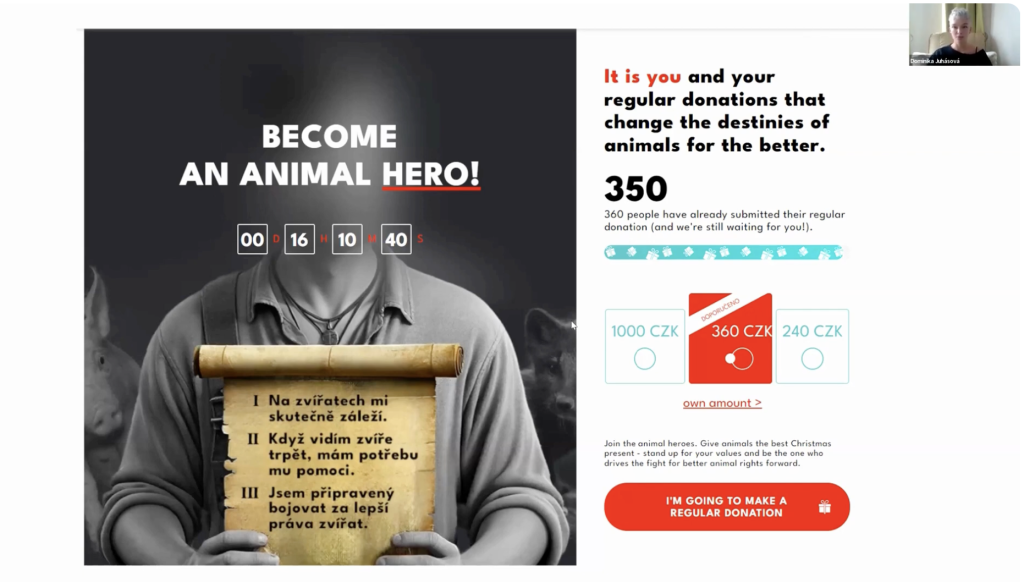
4. Break your campaign down into smaller goals and communicate success
Dominika Juhásová from Svoboda zvířat stresses (and the experience of other organizations confirms it) that it is proven practice to raise your goals gradually and, once a published milestone has been reached, to communicate the successes you have achieved.
If my goal is 300 recurring donors, I first announce that I want to reach 70, and once that is met, I can keep raising the goal. Plus, I have great material for further communication. Something has worked out, and we give other donors the chance to join something that is working brilliantly.
And let's not forget the FOMO effect. “I'd better not miss out, everyone around me is sharing it and it ends soon... I guess I'll join too.” As Getter Pärsim from Estonia says, “fear of missing out” is a real emotion that works in fundraising too. “FOMO” is the fear of missing an interesting opportunity, something that everyone around you is part of. Marketing specialists know very well how to make use of it on social media and in mailings.
5. Last chance! Make use of time milestones.
Pick a few milestones in your campaign that you will then use in your communication to motivate people to donate, whether they are fixed dates in the calendar or the achievement of partial campaign goals.
It could be, for instance, a significant international day, Christmas, the last day of the year
(31 December definitely works) or reaching a certain amount or a certain number of donors/heroes.
But beware, experience says: Don't send emails on 24 December during the campaign!
It has been tested that on this day people are not so much in the mood for donation requests, and open rates are very low. Even though this day can also bring results, other days will be more successful.
Don't forget to also use thermometers showing how much money you have already raised or how many donors you have gained and how much is still left.
A very interesting and effective tip (not only) from Ola Bujalska is also to use a calendar in your donor mailing with the days crossed off on which the person hasn't donated yet, and with today marked as the day that changes. Today is the day you become an (animal, human rights, ...) hero and make a difference with your donation!
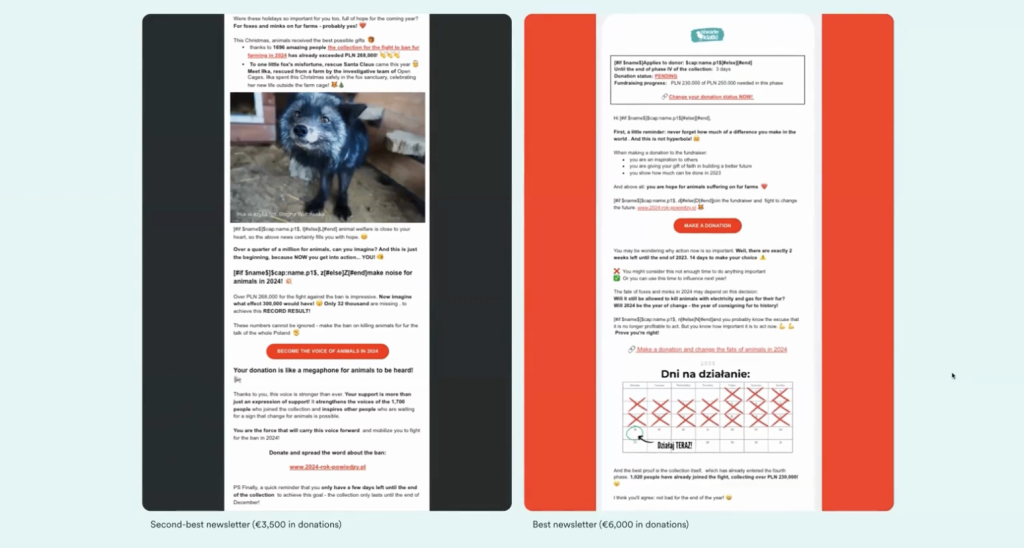
Example of an Otwarte Klatki (Poland) newsletter with a crossed-off calendar for donors
Countdowns of the days remaining until the end definitely help motivate donors to give as well. Also state the number of donors who have already joined the campaign.
6. Pre-launch. Don't launch a campaign without the first donations secured
In the first, non-public (pre-launch) phase, reach out to your closest donors before launching the campaign on social media. The first donors can inspire others to donate, and it is also a motivation for them to increase the impact of their donations. Holding a so-called call-a-thon has proven effective for this phase of the campaign.
7. Call-a-thon - make full use of telefundraising!
On the agreed day, you meet in the morning at the office with your colleagues, volunteers and telefundraisers (if you have any), spread out snacks and drinks around you, take a list of, say, 100 potential donors, and everyone starts calling. The less experienced or less daring can learn a lot from their more experienced colleagues, and next time it will be a piece of cake.
It's also good to have a simple call script ready. You can find out how to run such a call-a-thon here, for example.
Dominika Juhásová shared the success of their call-a-thon, where she and her team gained 17 new recurring donors in a single day.
You'll enjoy a nice day in touch with your supporters, and on top of that, you've organized a great team-building event. It seems that call-a-thons are already quite a common thing in the lives of our nonprofits. So give it a try too!
8. Work your way from the warmest contacts to the colder ones
In the pre-launch phase of the campaign, you therefore call, for example, one-time donors who recently sent a donation to one of your previous campaigns and ask them for a recurring donation. Next, you can continue with recurring donors and ask them to increase their donation. You also get in touch with your major donors, the most generous and most strategic ones, so that they help get the whole campaign rolling and become an inspiration for all the other donors.
In the public phase of the campaign, you then gradually use mailings to all segments of your database. And you add social media, where you also try to spread the campaign with paid posts to people who don't even know your organization yet.
9. Give it everything on the last day of the year, 31 December!
Or, in general, the last day of the campaign. Most people donate on the last day of the year. But then give a chance to the people who didn't manage to donate in time; you can extend the campaign, for example, until 3 January. Give everyone a chance and don't decide for the donors whether or not they feel like donating.
Your job, and let's be clear, the most important one of all, is to ask for a donation. Leave the rest to the donors.
10. Highlight the suggested donation amount
Raising the suggested amount on donation widgets can increase the average donation. In the case of Otwarte Klatki, it led to an increase in the average donation of EUR 2.30.
11. Don't be afraid to send more emails. More emails = more donors
More content means more donors. It has been tested, and the representatives of all the organizations agreed, based on their own tests, that a higher email frequency leads to higher open and click-through rates, and consequently to a greater number of donations. Really, don't be afraid of this step.
Dominika Juhásová encourages everyone. If you had something really important on your mind in your personal life, you would also talk about it often and with the appropriate emotion. The purpose of your campaign certainly deserves you giving it your all, and your communication won't put donors off. It's been tried and tested.
Akvilė from Lithuania adds that many things in our fundraising practice are counterintuitive, but despite your fears, be brave and let the results convince you!
12. Pick the low-hanging fruit!
Haven't run a “proper” campaign yet? Great! There's a good chance it will be successful if you reach out to the people who are close to you but whom you haven't asked for a donation yet.
The first campaign will take a lot of preparation, but the second time around you'll already have a ready-made web page, emails that worked, and you'll know how to run call-a-thons. The second time, campaign preparation will take half as long, and in the third year it will take only a third of the time.
13. Repeat your campaigns regularly every year. Even in hard times.
Akvilė Jurevičiūtė from Tušti narvai recommends repeating campaigns every year and also reusing the materials you have already created. That saves you work and time, and you can focus on optimization.
Plan for repeating the campaign already while you are preparing it. Take notes on the current campaign and record the results of your posts and emails in spreadsheets.
14. Use your materials again and again
Don't fix what works. The web page, the emails donors responded to best, or successful posts. Next year, you just tweak everything and use it again. You can even reuse some emails or letters in their entirety, exactly as they are, and send them to new contacts in your database.
Sure, it's good to keep learning and to be open to new ideas. But don't create extra work for yourself unnecessarily out of an excessive desire to be innovative.
And take at least a small lesson from your mistakes every year; you'll learn something each year, and your knowledge, skills and results will keep growing.
15. Reinvest in paid social media ads too
And do it gradually. As soon as your emailing brings in some money, reinvest part of it back into paid Meta ads posts on Facebook and Instagram. As soon as the first batch earns something, reinvest part of it again.
This approach can bring a twofold return on investment, as the experience of Otwarte Klatki (Poland) has shown.
16. Measure!
Use UTM parameters, evaluate your mailings and your social media results, and record everything for next time. You need to know what works and what doesn't.
Did you know, for example, that in email communication donors click most on links in boxes? The so-called supporter box works at the beginning of the email as well as in the middle; donors simply love it. And when you add a donor status to the box: “you haven't donated yet”, nobody can resist.
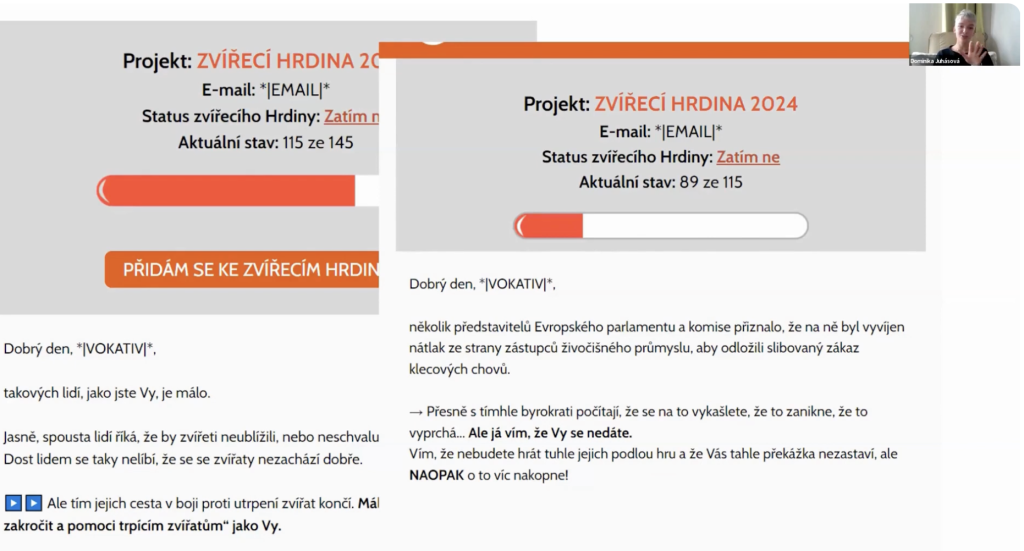
This is what a donor box with a donate button and the "animal hero" status looks like at the Czech organization Svoboda zvířat
17. Be flexible and optimize
Being a fundraiser means being flexible! We have to respond to the situation at hand and evaluate the results every day during the campaign. When things aren't going the way we imagined, we have to change something. And when things are going better than we expected, how do we make the most of it?
And finally, one slightly silly note: Don't forget to have some fun at work sometimes. A creative approach to your work can be a source of good mood for you, your colleagues and your supporters.
And to wrap things up, let's borrow Jiří's simple yet true and encouraging message:
It can be done, and you can do it too!
And we at Darujme.cz join in. We are here for you, and those of you who feel like diving into all of this right now, know that you are not alone.