Memorial for the Victims of the Shoah – Pinkas Synagogue
The Pinkas Synagogue of the Jewish Museum in Prague houses the Memorial for the Victims of the Shoah, which is unique worldwide due to its location, scale, and especially the period of its creation. In the 1950s, the names of over 77,000 Jewish victims from the Czech lands were inscribed on the synagogue walls. Expert research, as well as personal information from relatives, allows for the addition of missing names or the correction of existing inaccuracies. We also update this information in our online database, the “Digital Extension of the Pinkas Synagogue,” where we also aim to restore the faces of the victims through photographs. Support this project with us as a mark of respect for the murdered and as a reminder for future generations.
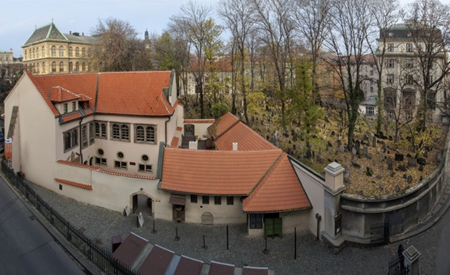
The Shoah Memorial is located in the Pinkas Synagogue, the second oldest preserved synagogue in Prague. The initiative for its creation came from Hana Volavková, the then-director of the State Jewish Museum. Between 1950 and 1954, the synagogue underwent extensive restoration to return it to its original form. Between 1955 and 1959, thanks to the symbolic connection between the synagogue space and the Old Jewish Cemetery, a metaphorical tombstone for the murdered Jews of the Czech lands was established. The memorial, one of the earliest of its kind, was created by academic painters Václav Boštík and Jiří John, who inscribed the names of over 77,000 Jews on the synagogue walls. Each name represents an individual fate and the record of a single life. For many, this remains the only place where they are remembered and honoured.
The inscriptions are arranged alphabetically by last place of residence before deportation or arrest, and then alphabetically by surname. Families, if identified, are listed together; other details include birth and death dates, which in most cases correspond to the date of deportation, the last known information about the victim. Most text is written in black. Town names and stars separating families are ochre, while surnames and the first letters of given names are in red. Names of victims from Prague are inscribed in the main nave, while victims from other towns are listed in the ground floor and first-floor gallery.
The memorial was opened to the public in 1960. Shortly following, problems with rising damp in the stone walls emerged, and the synagogue was closed in 1966. After the occupation of Czechoslovakia in 1968, the communist regime, which bore clear anti-Semitic characteristics, showed no interest in restoring the memorial. It was not accessible until after November 1989. The synagogue reopened in 1992, and the restoration of damaged original inscriptions was completed three years later. Further major repairs were required following the 2002 flood, when water reached a height of 120 cm inside the synagogue.
Since the 1990s, the inscriptions in the synagogue have undergone ongoing updates: newly identified victims’ names are added, incorrect birth and death dates are corrected, and sometimes name formats are adjusted. These findings come from our own research as well as help from relatives of the murdered. Newly added names mostly belong to individuals arrested before inclusion in mass transports, so they are not recorded in transport lists. Inaccuracies in birth dates and names are verified using Jewish registry books, while death dates are compared with data in a growing number of accessible Czech and international Shoah victim databases.
Restoration of inscriptions is a complex process, regularly carried out by renowned restorers. Incorrect inscriptions are removed using a mixture of alcohol and acetone, while new inscriptions are applied with oil paint thinned with lavender oil and damar varnish in rectified turpentine. Since many inscriptions are at considerable heights, scaffolding must be erected. All work is done without restricting the synagogue’s opening hours, allowing visitors to observe the process live. To date, over 300 new victim names have been added and approximately the same number of incorrect data entries corrected.
Information is also updated in our public Shoah victim database, the Digital Extension of the Pinkas Synagogue, which can be accessed via the information kiosk in the synagogue or online (https://pinkas.jewishmuseum.cz/en/search). Searches can be made by name, date of birth, or last place of residence. In addition to basic victim information, the database provides navigation to the wall where the inscription is located. A major effort is to attach photographs to individual victims. Since 2022, in collaboration with archives and relatives of the murdered, we have obtained more than 3,000 new photographs.
Share:
Support this project even more and ask your friends to help
Create campaign
To all those family members we lost.
Ray Constantine
€20
I am honored to administer a donation from people in England. This includes 3 generations of descendants of one Jewish family murdered in the Shoah. An unrelated person made a donation too. Very best wishes for your immensely valuable work continuing!
Alan Withington
€150
Thank you so much for this project for our families that suffered such great losses.
Adriel Resh
€50
we appreciate the work that the Project is doing to maintain the legacy and the memory of our lost loved ones.
thomas Mahrer
€20
Hello Lenka. I have sent 100e for your work. I’m still interested in publishing my book Chocolates from Tangier in Czech. I have the Czech done, just need the Czech publisher. It is clear that with the global “infidad@ we need to do more to educate new
Jana Zimmer
€100
It iis a privilege to be able to donate to this important project.




To all those family members we lost.
I am honored to administer a donation from people in England. This includes 3 generations of descendants of one Jewish family murdered in the Shoah. An unrelated person made a donation too. Very best wishes for your immensely valuable work continuing!
Thank you so much for this project for our families that suffered such great losses.
we appreciate the work that the Project is doing to maintain the legacy and the memory of our lost loved ones.
Hello Lenka. I have sent 100e for your work. I’m still interested in publishing my book Chocolates from Tangier in Czech. I have the Czech done, just need the Czech publisher. It is clear that with the global “infidad@ we need to do more to educate new
It iis a privilege to be able to donate to this important project.